Dynamic spec sheets for fast and flexible product information

At ERCO, product data sheets were traditionally created and delivered as static files. This project replaced that approach with dynamic generation based on structured data. This enables updates to be provided to customers significantly faster, more efficiently, more reliably and at lower cost.

Client
ERCO Leuchten GmbH
Year
2025
Klickmeister
Nils Polarek

Nils Polarek

Anton Zaitsev

Anton Zaitsev

Hendrik Bode

Hendrik Bode

Initial situation and objectives

The generation of product data sheets at ERCO was originally based on a static approach. HTML files were generated from article data for each language and each product, and then delivered via the website. With multiple languages and tens of thousands of products, this resulted in a very large number of static files.

This approach had one major drawback: limited flexibility. Changes to content, presentation logic or translations required not only updates to the underlying data, but also a complete regeneration of all affected HTML files. This process was time-consuming and made fast adjustments and iterative improvements significantly more difficult.

The objective of the project was to transition the product data sheets from a static to a dynamic system. Instead of pre-rendered HTML files, content would be generated at runtime from a central data source. This was intended to increase flexibility, reduce maintenance effort, and establish a foundation for a consistent and extensible presentation.

Result: Optimised product communication

The transition to dynamic spec sheets accelerates product communication while increasing control. Product information can be updated and delivered centrally without delay. At the same time, parts of the previous process chain have been significantly reduced or fully eliminated. New product offerings can be introduced more quickly, and existing ones can be developed more flexibly. A consistent data base across multiple channels minimises sources of error and provides the foundation for the development of future services.

Functional approach

In the new system, a product data sheet is no longer a static file, but the result of a data query. The required data is loaded from a database at runtime, and the data sheet is generated dynamically in the frontend. This is based on a structured data object that contains all relevant information for a product. The presentation still follows defined rules that determine how content is arranged and prioritised. Depending on the available data, layout and structure can adapt dynamically, for example in the positioning of light distribution curves or technical drawings.

A key advantage of this approach is direct adaptability. Changes to presentation, logic or content can be made centrally and deployed immediately, without the need to regenerate all content.

At the same time, the generation of the PDF version was also rethought. Instead of deriving content from the existing HTML output, PDF generation is now based on the same structured data object. This creates a consistent foundation for different output formats, regardless of whether they are generated in the frontend or backend.

Technical implementation

The technical foundation is a database-driven process in which product specifications are provided as structured data in response to a request. This data is processed in the frontend and converted into a visual representation. The previous reliance on pre-rendered HTML files is completely eliminated. Instead, the entire display is generated at runtime. This enables a clear separation between data storage, logic, and presentation.

An important aspect of the implementation is that the developed functions can be reused. To this end, the components for displaying and processing the specifications have been moved into a separate module. This module can be used and further developed independently of the specific application.

The implementation of PDF generation, in particular, benefits from the now-available complete structured product data. The creation of PDF data sheets is based on a standalone library that works directly on the structured product data and runs in both the client and the backend. Depending on the use case, the system relies on the same logic but uses different execution locations. For example, if a single PDF is generated by a user, the generation takes place directly on the client. If, on the other hand, multiple documents are to be created simultaneously, a backend service handles this process, generates the PDFs on the server side, and makes them available as a bundled download in the form of a ZIP archive.

The major advantage is that the same logic and the same central module are used in both cases. No additional detours via the browser are required. This makes implementation simpler, runs faster, and is less prone to errors.


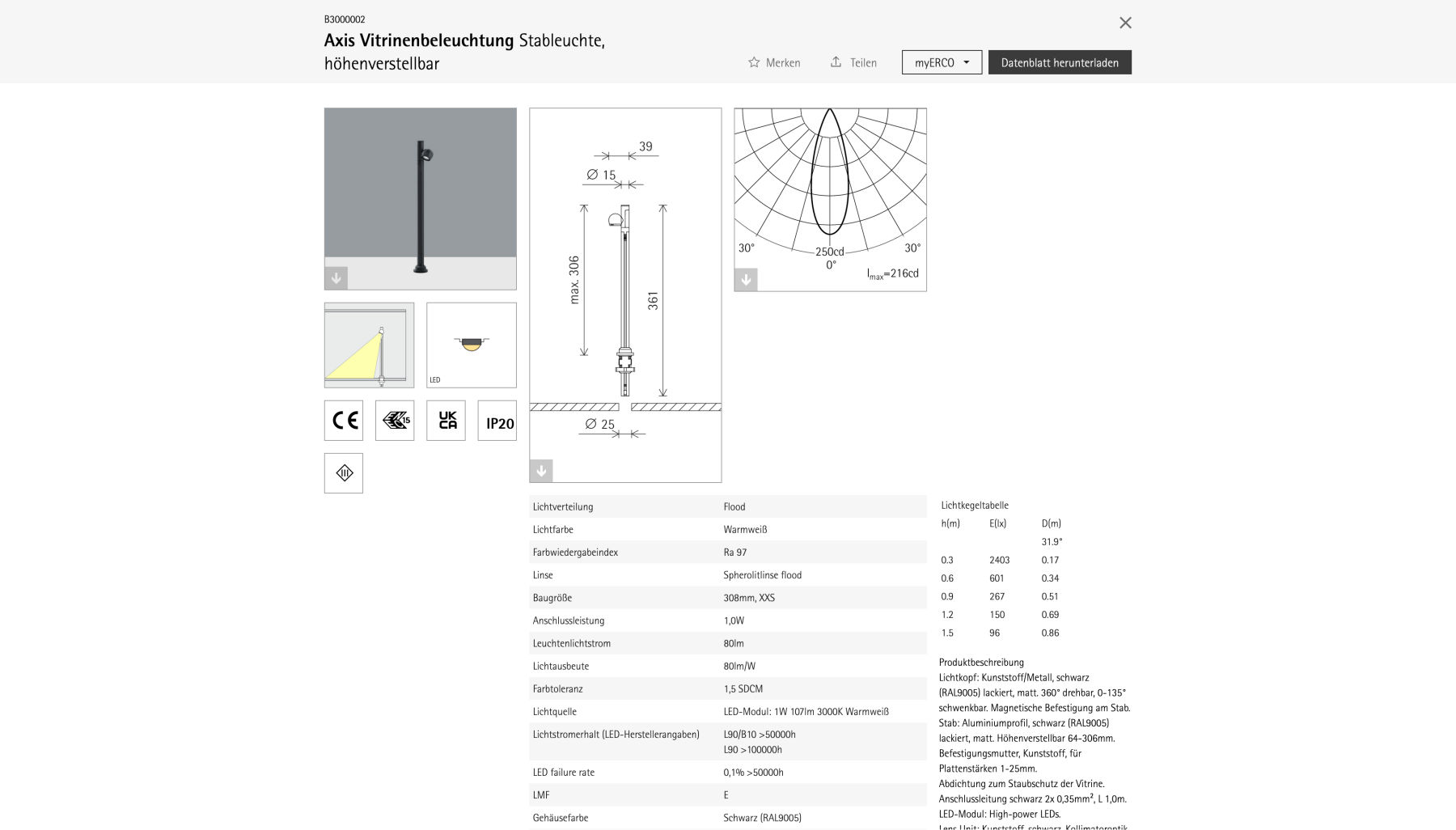
Real-time product specification: content, layout and technical details are based on structured data and generated dynamically in the frontend.

Maintenance and further development

With the transition to a dynamic system, the effort required for changes has fundamentally shifted. Adjustments to presentation, logic or content can be implemented centrally and deployed immediately, without the need for extensive generation processes. The decoupling of data, presentation and PDF generation also enables significantly more flexible further development. Individual components can be modified or extended independently of one another.

At the same time, data quality remains a critical factor. Since the presentation is directly based on the underlying data, inconsistencies become immediately visible. The maintenance and further development of the data structure is therefore an integral part of the system.

Challenges during the project process

The main challenge was ensuring the consistency and completeness of the underlying data. Different data sources contained partially conflicting information, which first had to be consolidated and standardised. In addition, the complexity of the presentation logic posed a significant challenge. The positioning and prioritisation of individual content elements follow numerous rules that depend on the specific data set. This logic had to be fully mapped in the new system while being structured in a way that remains maintainable.