Virtual Light Framework: Web-based solutions for lighting

Our virtual-light-framework enables the dynamic visualization of light directly on the website. It transforms existing planning data into an interactive, browser-based visualization in real time within the web browser, without the need for additional renderings or external design tools. This turns static data into a clear and interactive basis for decision-making.

Client
Klickmeister
Year
since 2025
Results
Klickmeister
Bernhard Kelm

Bernhard Kelm

Christian Noss

Christian Noss

Hendrik Bode

Hendrik Bode

Light. Interactive. In the browser.

  • upload_file IES Drag & Drop

    Drag IES files directly into the browser – visualization starts instantly, no upload dialog or external tools required.

  • radar Real-time analysis

    Cone diagram, iso-candela, and illuminance distribution are calculated live – parameters such as mounting height instantly affect all diagrams.

  • compare Compare & share variants

    Different arrangements and lighting scenarios can be compared directly and shared via a link with just a few parameters.

  • palette Fully customizable

    The framework is design-neutral – appearance, integration, and interaction fully adapt to the manufacturer’s corporate design.
For manufacturers – Leveraging digital planning expertise

Lighting manufacturers invest heavily in high-quality photometric data. Yet in digital product communication, this data is often reduced to downloads or static visuals. Variants must be visualized separately, comparison graphics are created manually, and renderings are commissioned repeatedly.

This is exactly where the Virtual Light Framework comes in. Using existing IES data and information on luminaire layouts, it generates an interactive lighting visualization that can immediately display grid dimensions, spacing, or variations. Instead of multiple static renderings, a dynamic system displays variants in real time and makes them easy to understand.

This reduces the need for pre-produced renderings, minimizes redundant media assets, and enables scalable integration of new products into the existing portfolio. Product data is no longer just provided – it becomes interactive. This strengthens the manufacturer’s position early in the planning process, reduces operational effort, and creates clear digital differentiation in the market.

For lighting designers – Evaluate variants early and make informed decisions

In the early stages of a project, fundamental questions arise: Which grid layout works best? How do uniformity and luminaire count change with larger spacing? Is a wide-beam variant more economical? Which light color best supports the concept?
Such comparisons usually require additional planning steps or separate visualizations in proprietary software tools.
The Virtual Light Framework allows these variants to be simulated directly in the browser on the manufacturer’s website. Different arrangements can be tested, products compared, and their impact on lighting effects becomes immediately visible. This accelerates the selection and design phase and provides a visual decision aid even before switching to planning software.
It also improves communication with the client. Lighting designers often face the challenge of explaining technical concepts in a way that is understandable—especially when clients or project stakeholders are not technical experts.
With the interactive visualization, variants can be explored together. Differences in grid spacing, luminaire count, or light colors become immediately visible and can be shared via URLs. Discussions shift from abstract parameters to directly visible lighting effects.

For decision-makers and clients - Understanding lighting effects

Technical curves and tables are difficult for many decision-makers to interpret. Virtual Light translates photometric data into a visual representation that makes the impact of lighting parameters, luminaire selection, and spacing immediately visible.
Differences between variants become clear at a glance. This increases transparency, confidence, and clarity in decision-making—especially in the early stages of a project.

Lighting visualization in the virtual Heitss mock-up room using cross-manufacturer IES data.

Dynamic simulation using existing data

The Virtual Light Framework transforms IES data into a real-time lighting visualization.
What previously required multiple static renderings is now generated dynamically in the browser: comparing different products, adjusting grid spacing, or evaluating light colors.
All calculations run client-side in real time.

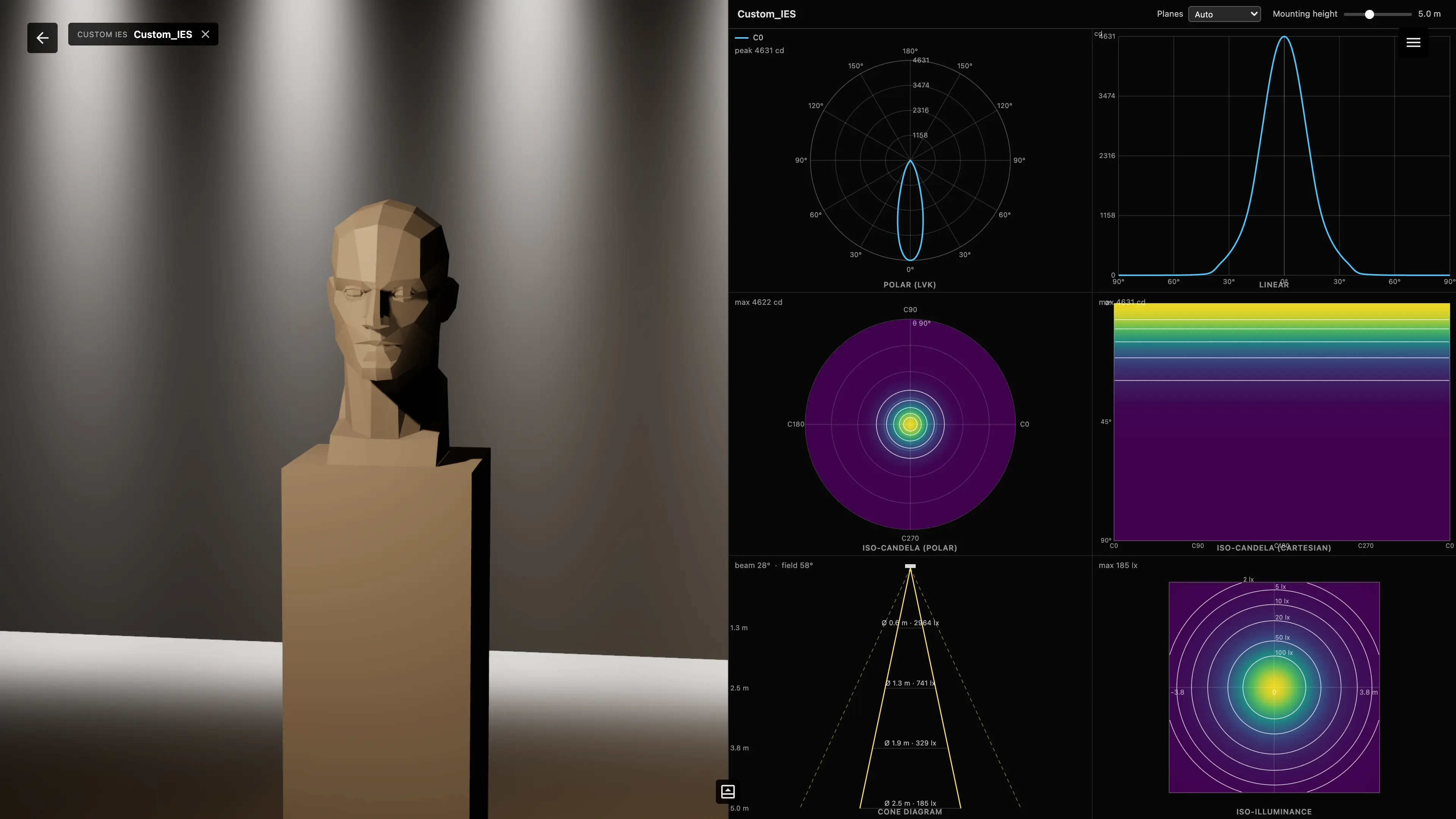
In addition to the 3D visualization, photometric analysis diagrams can be displayed that are otherwise only available in specialized desktop applications. The polar luminous intensity distribution curve and its linear representation show the luminaire’s radiation pattern in every direction. The iso-candela diagrams – in polar and cartesian form – make areas of equal luminous intensity visible at a glance. The cone diagram visualizes illuminance at different distances from the luminaire, while the iso-illuminance diagram shows its distribution across the working plane. Both respond immediately to changes in mounting height.

Individual diagrams can be exported directly.

Drag & drop IES files directly into the browser for display and analysis

Multiple output formats

In addition to interactive 3D visualization in the virtual mock-up environment, the Virtual Light Framework provides additional graphical and technical outputs.

These include 3D lighting visualizations, light distribution curves, and documented grid and layout variants. Direct comparisons between different luminaires can be generated instantly and used in presentations.
LDT tables can also be generated, planning parameters documented, and relevant performance and color data exported in a structured format. Planning information is therefore not only visualized, but also made systematically reusable.

Once data is generated, it can be used to create a wide variety of content that can be utilized both dynamically and statically.

Complete freedom in terms of design and application focus

The Virtual Light Framework provides a design-neutral technological foundation. It does not dictate how it should be integrated into existing websites, nor does it restrict design choices that align with corporate identity guidelines.

This open approach enables manufacturers to tailor visualization, interaction, and usage scenarios to their brand, products, and communication goals.

We would be happy to work with you to develop specific usage scenarios and concrete use cases that are optimally aligned with your manufacturing strategy.

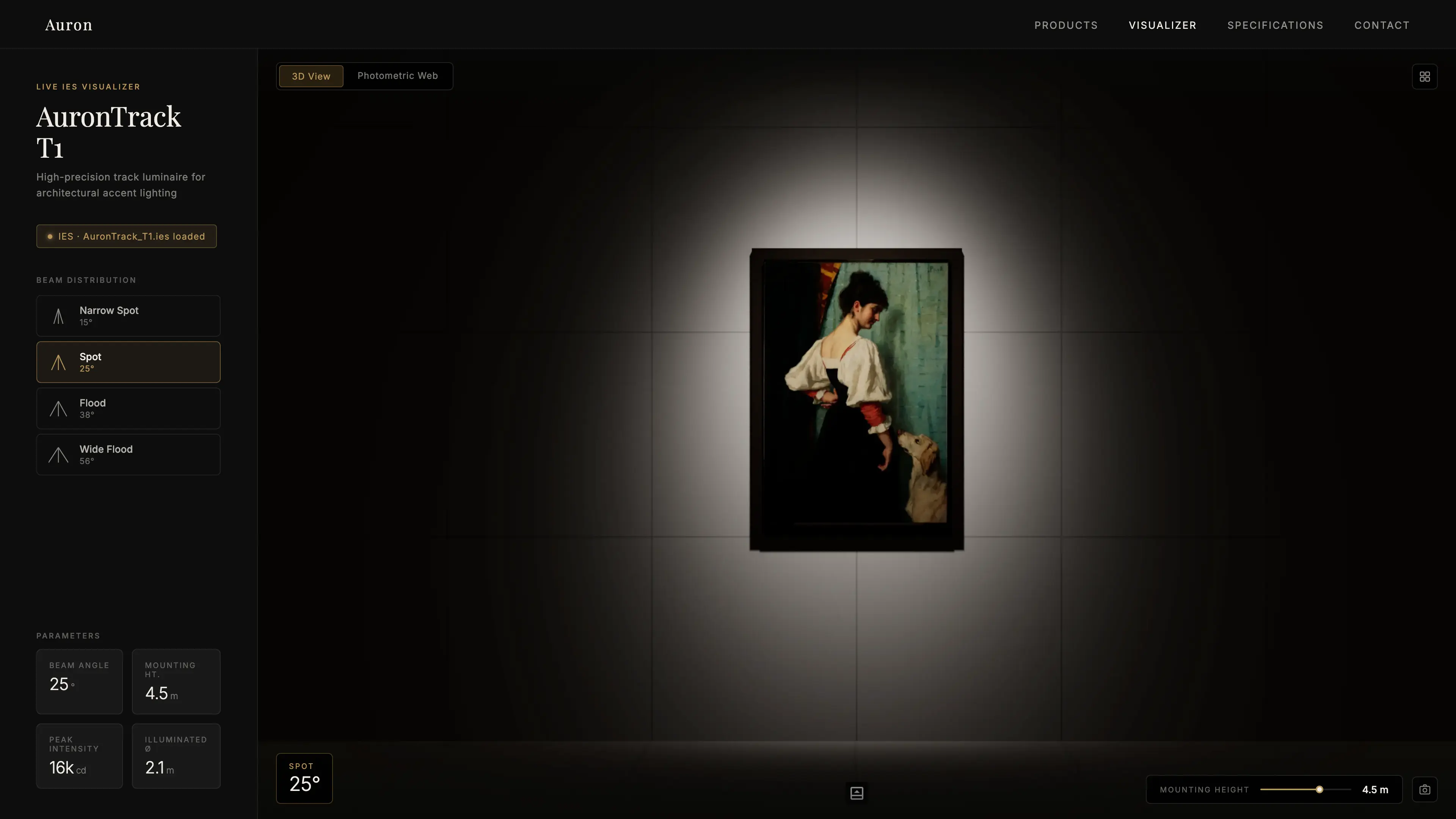
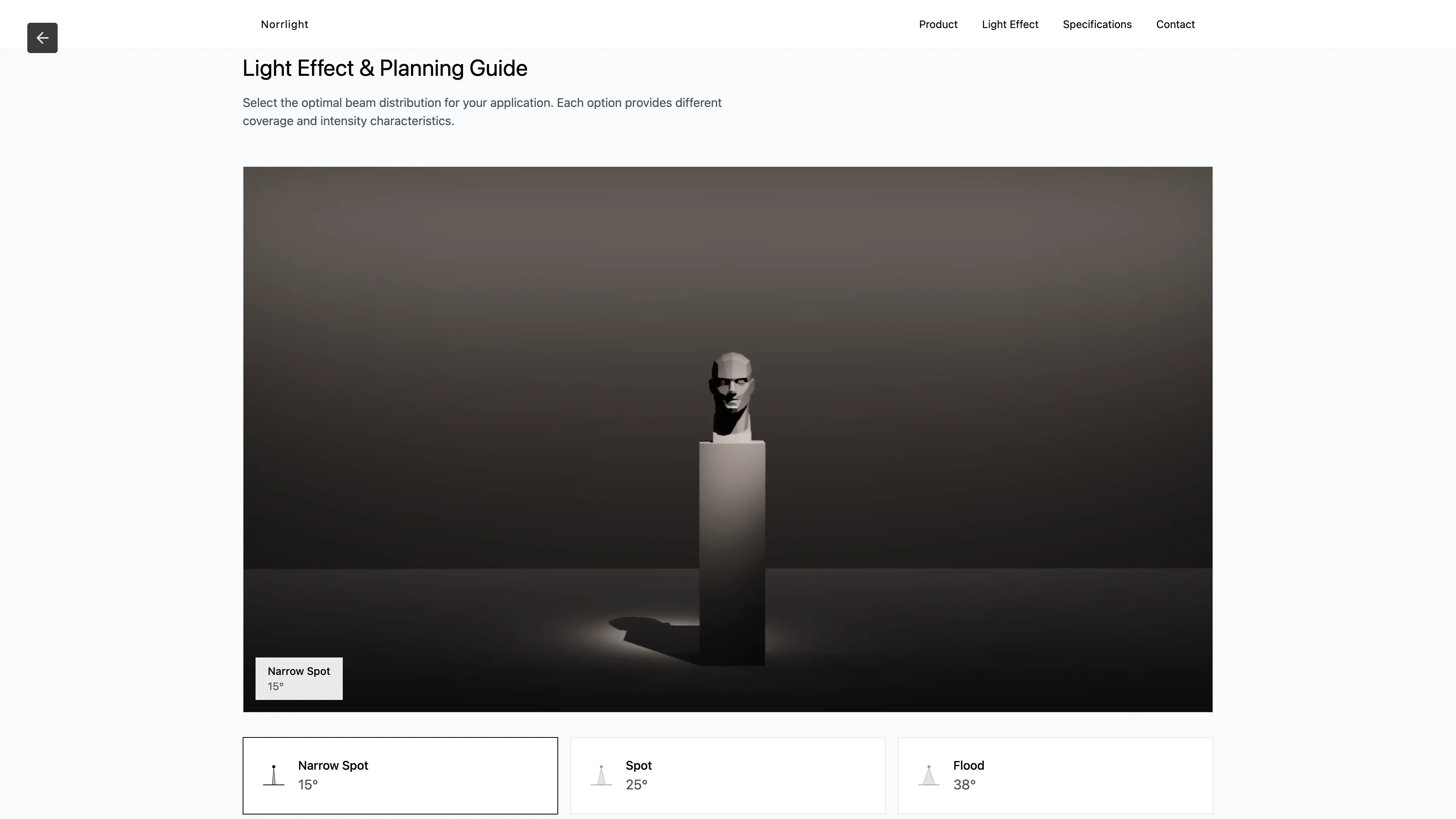
Fictional example: the Virtual Light Framework integrated into an alternative corporate design.

More web-based solutions for lighting!

  • More about Light Finder: Guided Product Search for the Right Lighting Solution
    ERCO Leuchten

    Light Finder: Guided Product Search for the Right Lighting Solution

    For ERCO, the internationally operating specialist in high-end architectural lighting, we developed the Light Finder nbsp;– an innovative software tool that enables users to independently navigate the extensive product range and select suitable lighting solutions for their individual lighting requirements.

    • Custom Software
    • Frontend
    • Consulting
    • Prototyping
    • UX/UI
    • DevOps
  • More about An image-driven Website, Optimized for Mobile Devices
    Kober Lichtplaner

    An image-driven Website, Optimized for Mobile Devices

    For Kober Lichtplaner, an architectural lighting design studio, we developed a multilingual website that showcases the team’s projects to their best advantage.

    • CMS
    • Frontend
    • SEO/SEA
    • B2B
    • Hosting
    • Responsive
  • More about Track Configurator: from Planning Concept to Bill of Materials
    ERCO Leuchten

    Track Configurator: from Planning Concept to Bill of Materials

    For ERCO, the international specialist in architectural lighting, we developed the track configurator – a web-based tool that enables users to independently plan complex track systems and translate them into a technically valid bill of materials.

    • Architects’ Darling
    • Custom Software
    • B2B
    • System Architecture
    • Frontend
    • Data
    • Consulting
  • More about The Invia Configurator for a Complex Product Family
    ERCO Leuchten

    The Invia Configurator for a Complex Product Family

    For ERCO, the international specialist in architectural lighting, we developed the Invia configurator – a tool that structures the planning of complex trunking systems and enables users to configure modular systems precisely and in a technically valid way.

    • Architects’ Darling
    • Custom Software
    • B2B
    • Frontend
    • Data
    • Consulting
  • More about Dynamic Spec Sheets for Fast and Flexible Product Information
    ERCO Leuchten

    Dynamic Spec Sheets for Fast and Flexible Product Information

    For ERCO, the international specialist in architectural lighting, we developed a system for dynamically generating product data sheets – based on structured data that controls content, layout and output formats in real time.

    • Data
    • B2B
    • Performance
    • System Architecture

Interested in the topic of lighting on the web?

Get in touch – we look forward to an open exchange and finding new solutions together.