Virtual Light Framework: Experience Light Interactively, Publish Product Data Efficiently

Our Virtual Light Framework generates an interactive lighting visualization from your lighting data (IES, LDT, or GLDF) – calculated in real time directly in the browser and supplemented with photometric charts.

What the Virtual Light Framework Enables

  • touch_app Experience Light Yourself

    Designers can test layouts, variations, and installation parameters on your website – and see immediately how the lighting changes. Each variation can be saved and shared.

  • visibility Everything Right in Your Browser

    No planning software, no installation, no barriers between interest and trying it out.

  • hub Manage Once, Use Everywhere

    A single file serves as the source for 3D views, photometric charts, and variant comparisons – enabling dynamic product communication.

  • layers_clear Efficiently Scalable

    For each new product, all you need is a new data entry – no rendering job, no photo shoot, no second product feature.
From Pre-Produced to Dynamically Generated

LED lighting technology offers virtually unlimited design freedom in terms of light color, appearance, beam angle, and mounting type. This allows product lines to expand, creating an ever-increasing number of combinations and lighting effects. Product communication requires light distribution curves, tables, renderings for specific application scenarios, and illustrations for spec sheets. For traditional, static publication processes, this is a scaling nightmare: a few thousand products can quickly turn into tens of thousands of assets that must be created and maintained.

The Virtual Light Framework counteracts this multiplier effect by making the standardized lighting source file (IES, LDT, or GLDF) the single source of truth. The required visualization is no longer created in advance as a finished file, but rather at runtime. The benefit is twofold: a dynamically interactive visualization for your customers and efficient scaling of your product line.

Clarify Questions Before Making a Product Decision

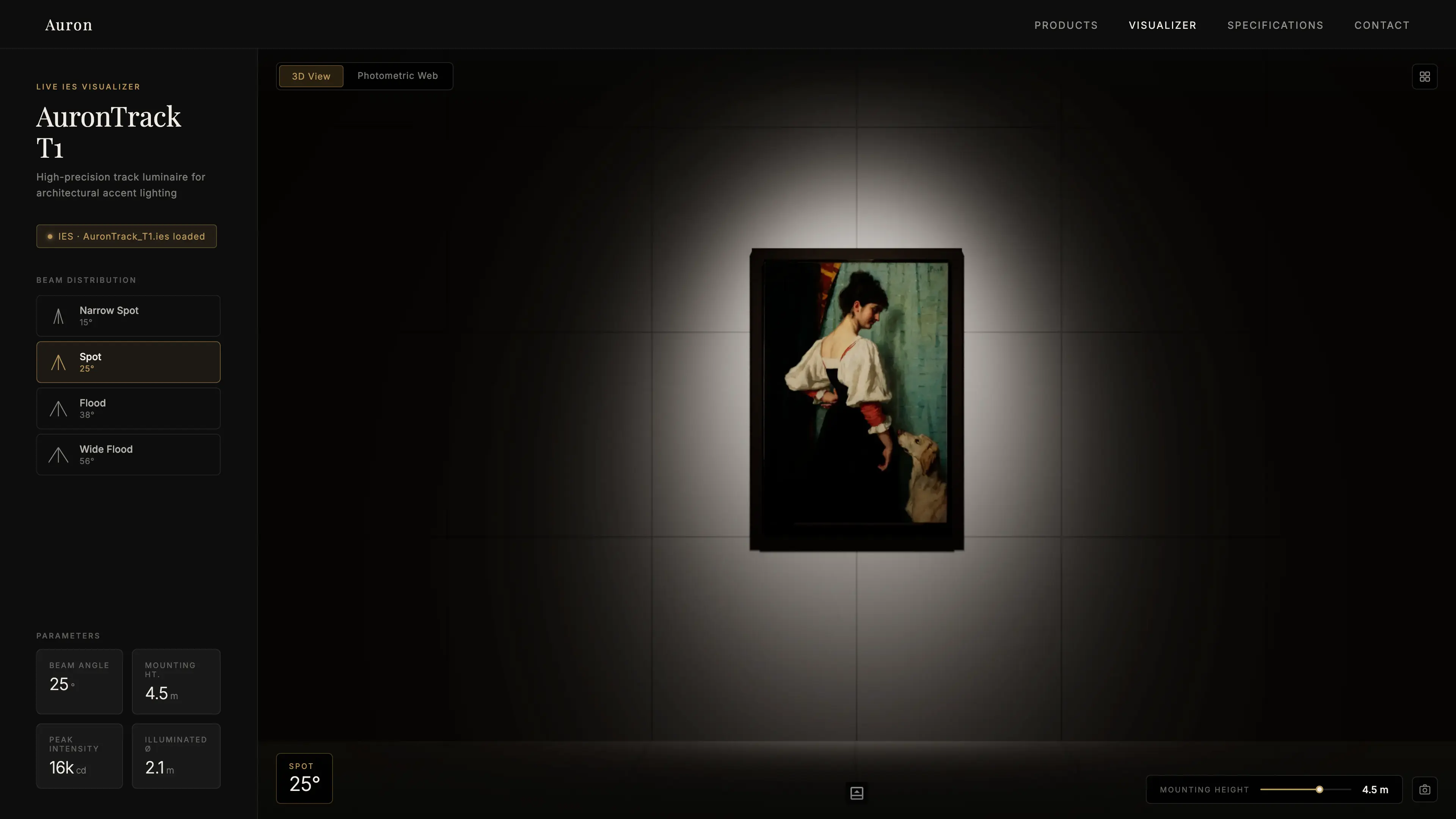
In the early stages of a project, fundamental questions often arise: Is a wide-beam version more cost-effective? Which light color better supports the design concept? How does the light distribution change at different mounting heights? Such comparisons typically require additional planning steps or specialized visualization software. With the Virtual Light Framework, your users can answer these questions directly on your website by switching between luminaires or variants, adjusting mounting parameters, and comparing light distributions.

This also helps when discussing projects with clients, who are rarely lighting experts: Technical relationships become immediately apparent, and the discussion shifts from abstract technical specifications to the tangible effects of light. The Virtual Light Framework provides an additional decision-making tool early in the selection process – an accessible visualization of light directly in the browser. It complements lighting design but does not replace it.

Directly on the website: Visualization of lighting effects in the virtual mockup view based on IES data.

Charts, Graphs, Tables – from a Single File

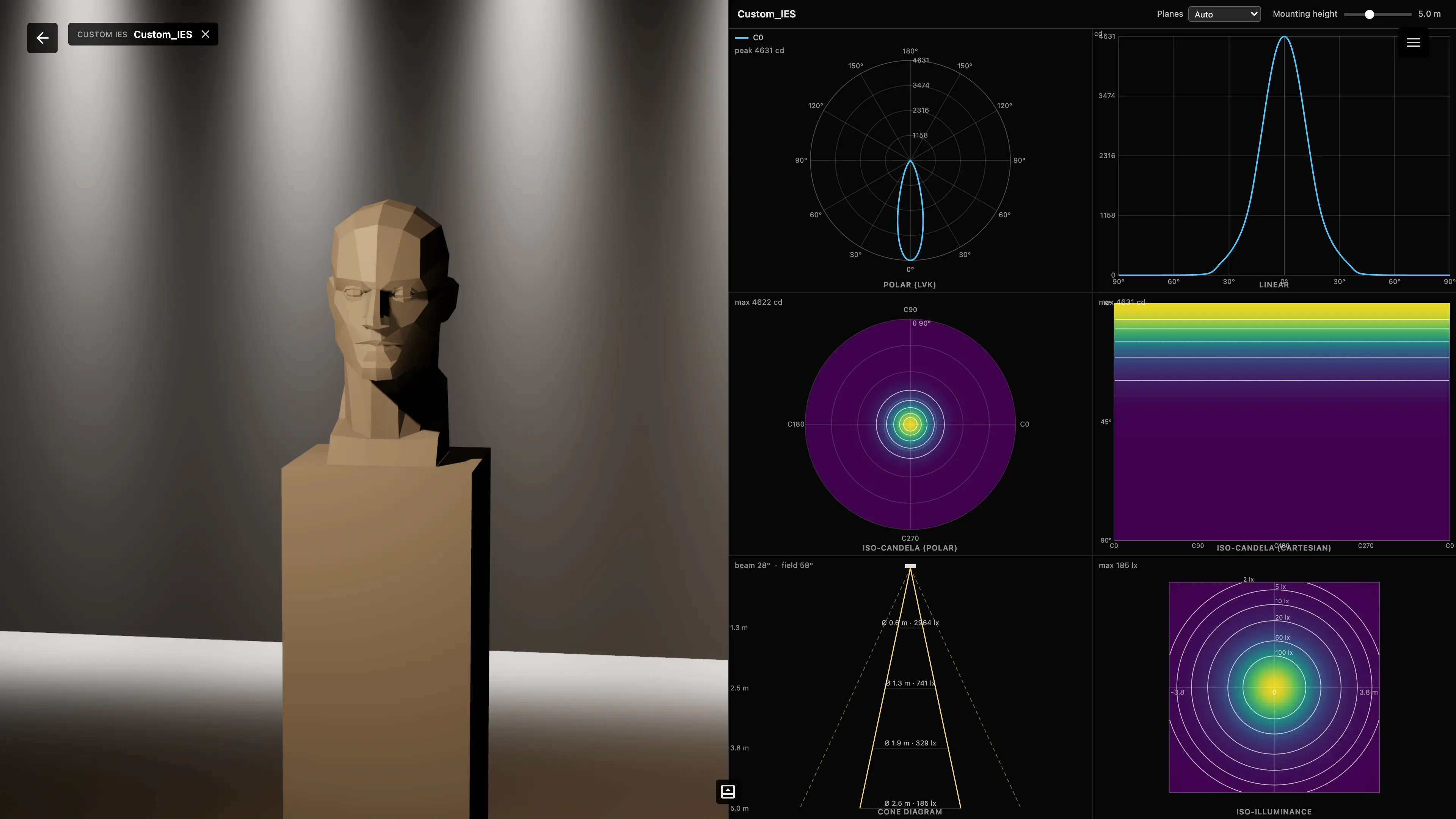
In addition to the 3D visualization, photometric analysis diagrams can be displayed that are otherwise only available in specialized desktop applications: the polar luminous intensity curve (LVK) and its linear representation, isocandela diagrams in polar and Cartesian forms, the cone diagram, and the isointensity diagram. All of these respond immediately to changes in mounting height and can be exported individually.

View and analyze IES files directly in the browser using drag-and-drop

GLDF: The Next Logical Step

The Global Lighting Data Format combines photometry, geometry, and product variants into a single open container – thereby going beyond mere lighting simulation. The Virtual Light Framework uses GLDF to merge two traditionally separate strands into a single view: product representation and lighting simulation. A GLDF file reveals not only the lighting effect but also the luminaire itself – with its body, in space, and within the grid. Using the joints defined in L3D, it swivels and rotates exactly as the product actually allows, and the light distribution follows every movement.

Because a GLDF container describes a product’s variants in a modular way, our framework displays not just a single luminaire, but the entire variant tree. This moves the concept toward a complete digital product representation: Structured data is transformed into a dynamic web application that makes geometry and variants accessible in addition to the lighting effects.

Paths to Integration

The Virtual Light Framework integrates into your existing website as a standalone module. No website relaunch, no changes to your corporate design. There are three options:

Embedded. We provide you with a ready-to-use embed code – an iFrame that your team can place wherever you want. We handle operation and updates. A simple use case, for example, is for product detail pages.

Integrated. The framework is loaded into your page as a script and runs as part of it. Using JavaScript, you can adjust parameters to control the display, product selection, and behavior. The processes on your page remain unaffected, and you have more control over the layout and how it interacts with your other content.

Interwoven. Should the framework become an integral part of a configurator or your own application? In that case, it’s available as a web component, provided as an npm package via a private registry. You’re in control: set up scenarios, switch products, retrieve results – and roll out updates whenever it suits you.

You decide how deep the integration goes. Your team can handle the integration themselves, or we can do it as an agency – the decision usually depends less on the technology than on internal capacity.

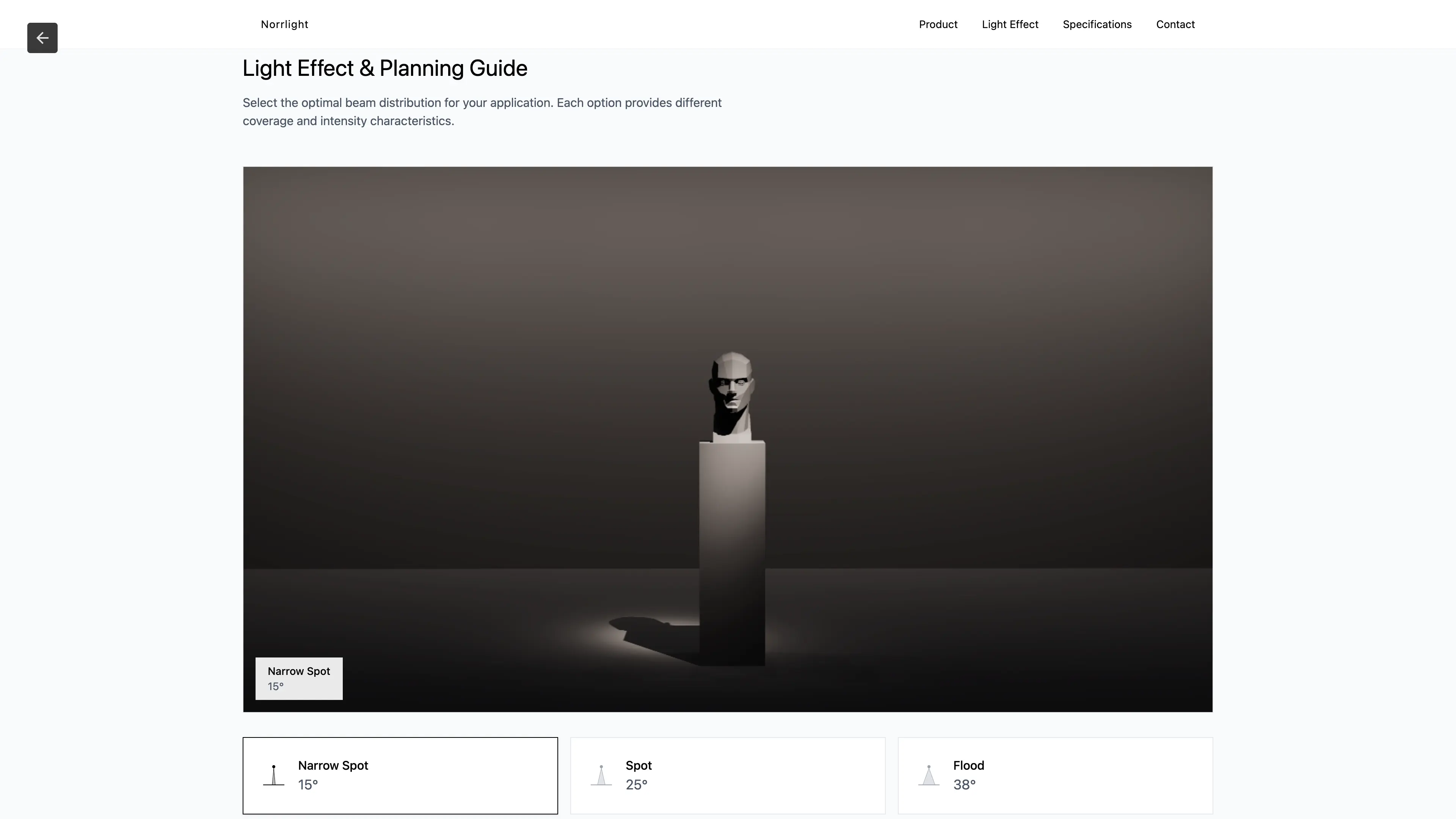
Fictional example: The Virtual Light Framework integrated into an alternative corporate design.

More Web-Based Lighting Solutions

What can you do with your lighting data today?

Please feel free to contact us – we look forward to an open exchange and dialogue so that we can find new solutions together.